


So why just Claude Training?

Claude is the dominant force in AI right now.
Anyone paying attention can see it. It’s the model businesses reach for when the output actually matters. When the document goes to a client. When the code goes to production. When “roughly right” isn’t good enough.
But our story with AI didn’t start with Claude. It started years before, when the answer to “which model should we use?” was a lot less obvious. When every month brought a new leaderboard, a new release, a new reason to rip out what you’d built and start again.
We lived through all of that. Built through all of that. And came out the other side with a very clear answer.
This is the story of how we got here. Why we spent three years building AI systems for real businesses, why we tried everything else first, and why we’ve now made the decision to run London based Claude training courses, rather than just build with it.
Three years in the trenches
Before AI First Training there was AI First Agency.
For the past three years we’ve been advising on and implementing AI systems for businesses. Not writing think pieces about AI. Not selling “AI strategy” decks that gather dust in a shared drive. No. Actually building the things. Custom assistants, automations, LLM wrappers, account manager agents, full internal tooling shaped around how real teams actually work.
And the work covered the full messy range of what businesses genuinely need. Client-facing chat systems that had to stay on-brand and on-message with nobody supervising them. Document pipelines that turned raw calls and notes into finished deliverables. Reporting systems that pulled from half a dozen tools that were never designed to talk to each other. The kind of work where the demo is easy and the last 10% takes three times longer than everything before it.
Three years of that teaches you things no benchmark ever will.
It teaches you where models quietly fail. Which ones follow a 40-step instruction set and which ones drift off after hop 12. Which ones hold a brand voice across 500 outputs and which ones collapse into generic AI mush by output 50. Really: which ones you can trust with a client’s name on the work and which ones you can’t.
It also teaches you that most of what’s written about AI online is written by people who have never had to support a system in production. The gap between a viral demo and a tool a business relies on every day is enormous. We’ve crossed that gap dozens of times. We’ve also had to let clients down and tell them that the no-code solution promised to them in that TikTok video they saw last night is, unfortunately, a 6 month custom Azure / Python / SvelteKit custom build that will cost 20x their proposed budget.
Or, even worse, not possible at all. As the tool will inevitably hallucinate where there is no room for doing so. Even today, I find, we still have to explain to peers far too frequently that hallucination is not something that will be ironed out, only minimised. That hallucination IS the technology. At least in its current iteration. But I digress.
Which is exactly why our conclusions about Claude carry some weight. We didn’t arrive at them from a keynote or a benchmark chart. We arrived at them from production systems with clients waiting on the other end.
We tried everything else first
We started where everyone started: OpenAI.
In the early days that was the sensible choice. The models were capable, the tooling was maturing fastest, and clients had at least heard of ChatGPT, which made the sales conversation easier. We built a lot of good systems on that stack, and we learned the fundamentals of production AI work there: prompt design, evaluation, guardrails, cost control, all of it.
Then the work got more demanding, and the first fork in the road appeared.
Some clients needed self-hosting. Some had safety-critical implementations where the data simply could not leave their own infrastructure. Regulated industries, sensitive internal documents, systems where a third-party API was a non-starter no matter how good the model was. So we moved into Chinese open-source models, running them on our own hardware, tuning them for specific jobs.
And for what they were, they were impressive. Genuinely. The pace of the open-source scene was remarkable, and for narrow, well-defined tasks behind a firewall, they earned their place. We’d still recommend that route for certain problems today.
But here’s the thing about building AI systems for businesses. The bar keeps rising.
Every system we shipped made clients want the next one to do more. Handle more nuance. Make more judgment calls. Produce output that didn’t need a human babysitter checking every line before it went anywhere. The gap between “pretty good” and “good enough to ship without review” turned out to be enormous, and it’s exactly the gap where projects go from profitable to painful.
Because when a model gets it 90% right, someone still has to review 100% of the output to find the 10%. The economics barely move. The magic number is the one where you can stop checking.
The systems we were creating demanded more and more quality at the output end. And one model kept clearing the bar the others couldn’t. That’s when we switched to Claude as our backend LLM.
And we’ve never looked back. Every serious build since then has been Claude at the core, and every single time the quality gap justified the decision. Some of our most current projects are simply impossible using any other LLM.
The project that settled it: our very own LSM App
One build in particular turned us from a team that used Claude into a Claude-centric team.
Our sister company, Love Social Media, needed to automate the creation of hundreds of social media assets every single day. Real client work, real deadlines, and clients who could not afford even the smallest error.
The problem was brutal:
- Limited pixel space on social graphics
- Artistic direction that had to hold up across every asset
- 100% brand alignment, every time
- Custom fonts rendered correctly
- Logos that kept their integrity instead of melting into AI soup
Pure image generation couldn’t do it. No model renders a client’s exact logo and exact typeface reliably, hundreds of times a day.
The only way to deliver was live HTML templates that the server renders out to finished graphics. Imagery generated with GPT Image 2, but the orchestration and the HTML templates themselves? Only Claude Opus could handle that. Not even Sonnet could handle it, though we certainly tried hard to make it work, given token costs. Nothing else came even close. And because the requirements were far too complex for any no-code tool, we built the entire backend with Claude Code too.
The result: a fully-fledged platform. Multi-tenant, organisation and user scoped, with co-working, comments, notifications and much more. Built, tested and shipped in just three months.
A similar system would have taken us closer to a year not long ago. And the quality jump was the part that really got us. We went from manually correcting dozens of templates a day that failed QA, whether produced by other AI systems or outsourced to designers, to just 3 or 4 fixes in a batch of 100.
That was the moment we knew Claude for Business was the future. Not a benchmark. A production system, running daily, that simply worked.
[IMAGE PLACEHOLDER: LSM App interface screenshot, or a before/after grid of rendered social graphics]
Then Claude changed the game again
Here’s where the story takes its turn. While we were busy building custom systems on top of Claude, Claude itself kept absorbing the things we were building.
Think about what’s shipped in the platform recently. Design work that used to need a separate tool. Cowork, which turns Claude from a chat window into something closer to a colleague working through files and multi-step tasks on its own. MCP servers connecting Claude directly to the tools businesses already run on: their CRM, their calendar, their email, their project boards, their meeting recordings. Skills that let you package your company’s way of doing things into reusable instructions any team member can trigger. Artifacts, file creation, proper document output.
A year ago, “connect the AI to our systems” was a custom project with a budget and a timeline. We know, because that was often the project.
Today, for a huge slice of businesses, it’s a settings menu, a spread of skills and a sprinkle of tooling.
The platform has evolved so much that most low to medium complexity business workflows can now happen inside Claude itself, with minimal custom code. Client reporting. Proposal drafting. Meeting follow-ups. Research and analysis. Content production. Data cleanup. The daily operational grind that eats most of a team’s week.
Which put us in a slightly awkward position as an implementation agency, if we’re honest.
We’d scope a custom system for a client, and halfway through the build we’d catch ourselves thinking… this might be a native Claude feature by the time we ship it. This has actually happened more than once. It stopped being funny quick.
Some agencies would see that as a threat and keep quiet about it. Keep selling the six-month builds while the platform quietly makes them redundant. We saw it as the writing on the wall. We also saw it as the most exciting development in years. Because if the platform can do the work, the bottleneck isn’t the technology anymore.
It’s whether your team knows how to use it.
That realisation is why AI First Training exists. The highest-value thing we can do for businesses right now isn’t building them another system that Claude will eventually make redundant. It’s teaching their people to run the platform themselves.
We’ve done the training thing before. At scale.
This is the part of the story most people don’t know.
Before AI First, before Love Social Media, there was Academy Class. One of the UK’s largest creative IT training companies. Mark owned and ran it for 15 years. I was his marketing director there for over four years, about ten years ago.
Thousands of delegates. Courses running across the country, year in, year out. Adobe, Autodesk, the full creative and technical stack of that era, taught to the professionals who used those tools for a living and couldn’t afford a wasted day out of the office.
That business taught us the unglamorous machinery of professional training, done properly. How to design a curriculum that survives contact with a real classroom. How to find trainers who can actually teach, not just demonstrate. What class sizes work. How much hands-on time a skill needs before it sticks. What post-course support has to look like for the learning to survive the delegate’s first week back at their desk.
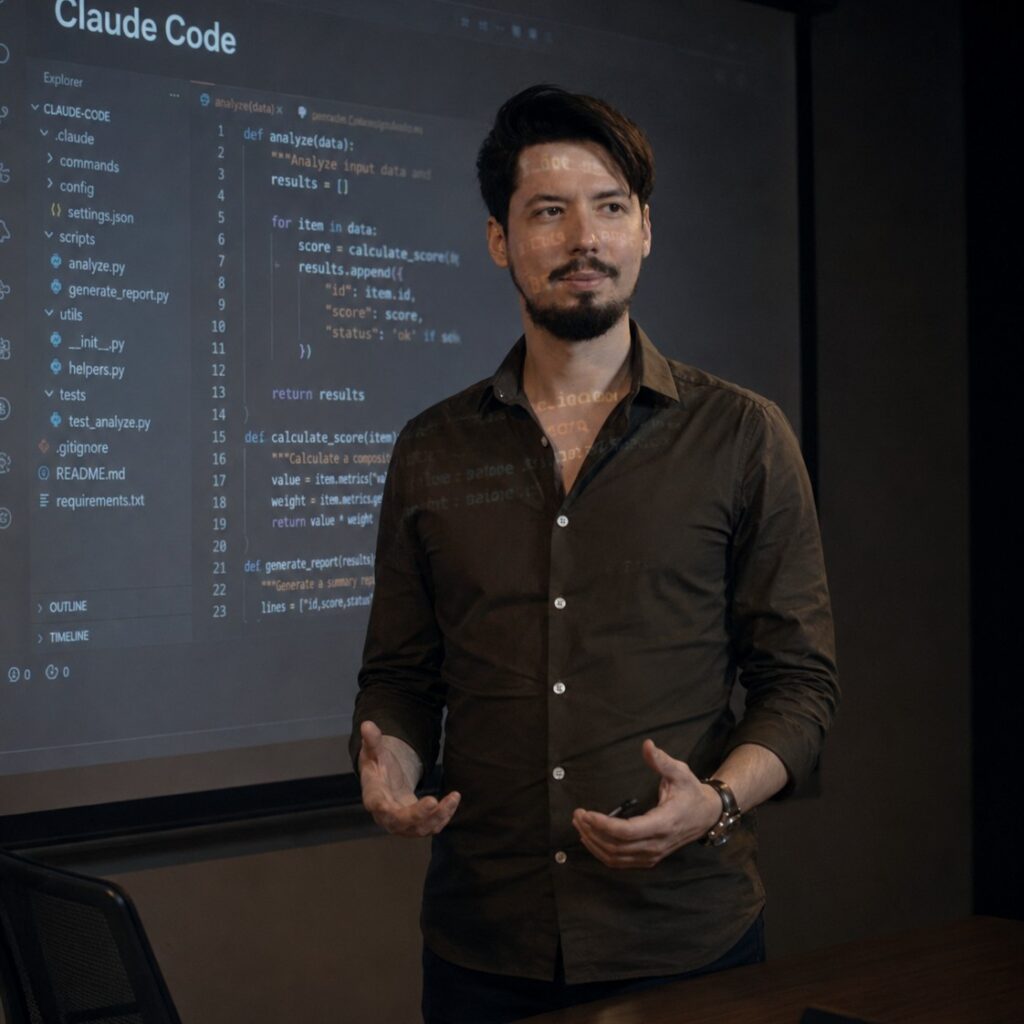
None of that is glamorous. All of it is the difference between a course people rate 5 stars and forget, and a course that changes how someone works.
We just needed the right thing to teach.
And frankly, the AI training space needs people who’ve done this before. Right now it’s full of people who discovered ChatGPT eighteen months ago and printed a certificate. The tools are new. The craft of teaching professionals isn’t. We happen to have both.
Everything converged
So look at the pieces:
- Three years of hands-on AI implementation on real business problems with real stakes
- A genuine passion for this technology.
- The discovery that Claude is the clear winner. Not on vibes. On shipped systems
- Our own proof that Claude solves REAL business problems, because we deployed it to solve ours first
- Peers switching in numbers. More and more of the businesses around us now run through Claude
- 15+ years of running a big, successful training company between us
Was there ever really another path?
Everything converged to make AI First Training happen. It didn’t feel like a pivot. It felt inevitable.
The 80/20 we can’t wait to teach
Here’s what gets us out of bed now.
Most businesses have no idea how much of their daily work Claude can already handle out of the box. Our estimate, from doing this every day: you can get 80% of what you need purely through the platform as it is right now.
What does that 80% actually look like? The documents and reports that eat your afternoons. The analysis of that spreadsheet nobody wants to open. Client comms drafted in your voice, not robot voice. Research that used to take a junior a full day. Meeting notes turned into action lists and follow-up emails before you’ve made your next coffee. Proposals, presentations, project plans.
No developers. No six-month projects. Just your team, trained properly, using Claude as the central operating system for the business.
That 80% alone transforms most companies. We’ve watched it happen. A team goes from “we have a ChatGPT licence somebody uses sometimes” to genuinely restructuring how work flows through the business, usually within weeks of proper training.
But then there’s the other 20%.
The custom connections to systems MCP doesn’t reach yet. The no-code integrations that stitch Claude into your existing automation stack. The workflows that genuinely need a bit of custom code, which Claude Code can help your own team build, without hiring a development agency. That 20% is where things get truly interesting, and where a business stops using AI and starts running on it.
We teach both. The foundations that get your whole team productive fast, and the advanced builds, tools and integrations for the teams who want to go all the way.
Every course is led by someone who uses Claude in a real business every day. Because that’s the only kind of trainer we’d have wanted in the room ourselves.
Come and see for yourself
We’ve been on both sides of this. We’ve built the systems, and now we teach the skills.
If your team is still copy-pasting into a chatbot and calling it AI adoption, there’s an enormous amount of value sitting on the table. Not theoretical value. The kind we’ve measured in our own businesses, in hours saved, in output quality, in a platform built in three months instead of a year.
Browse our Claude training courses or give us a call on 020 3051 4321. We run classroom sessions in London, Edinburgh, Manchester and Plymouth, plus online, on-site and 1-to-1 formats.
We’d love to show you what this platform can really do.